
Introducing the Emotions Explorer
Sometimes a plain list of emotions is a useful start. But when you’re trying to understand what you or a client is actually feeling, a long list of words can make you glaze over, and give up.
The Emotions Explorer was built to go further. It helps you move from vague feelings, or blunt emotions like “anger” or “sadness” into more precise emotional language. Allowing you to go into wider context, specific patterns, and take on practical reflection.
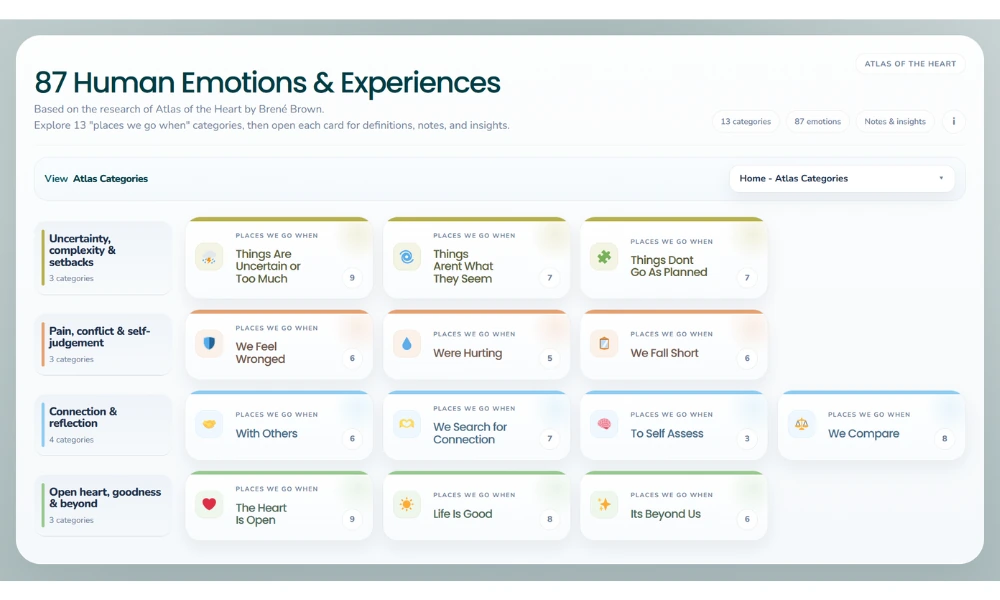
Instead of just scanning a list, you can explore emotions by category, view them through the Life Values Alignment Grid, browse relational patterns, and even sort them by energy and pleasantness for a more visual understanding of emotional experience.
What makes this especially useful is that it helps you see the difference between an emotion, a mindset (or cognitive state), and a behaviour.
Share a Rich Emotional Language
Many people might say things like “I feel bad”, “I’m stressed”, or “I’m angry”, but that often hides something more specific underneath.
This tool helps you walk that path, taking your on a journey of discovery – in a way that feels structured, visual, yes flexible and easy to explore.
The key is its rich emotional granularity, pattern recognition, and prompts for reflection. All this helps you have rich, meaningful conversations, whether in sessions with clients, or with friends, family, team-mates or co-workers.
Therapists in particular will find it a powerful tool for leading sessions, starting conversations, delivering psycho-education, coaching, or even for your own personal development.
At the core of the Emotions Explorer are the ‘Atlas of the Heart’ emotional categories and definitions inspired by Brené Brown.
I’ve brought them into an interactive format that helps you click into these emotional clusters, compare nearby experiences, and explore detailed cards with definitions, notes, related categories, and insights.
That means you are not left guessing what a word means, or whether two feelings are really the same. The work has been done. You can explore the emotional terrain in a more relatable and precise way.
Starting with the “places we go” often feels immediately familiar and strikes a chord.
A Helpful Tool for Deeper Work
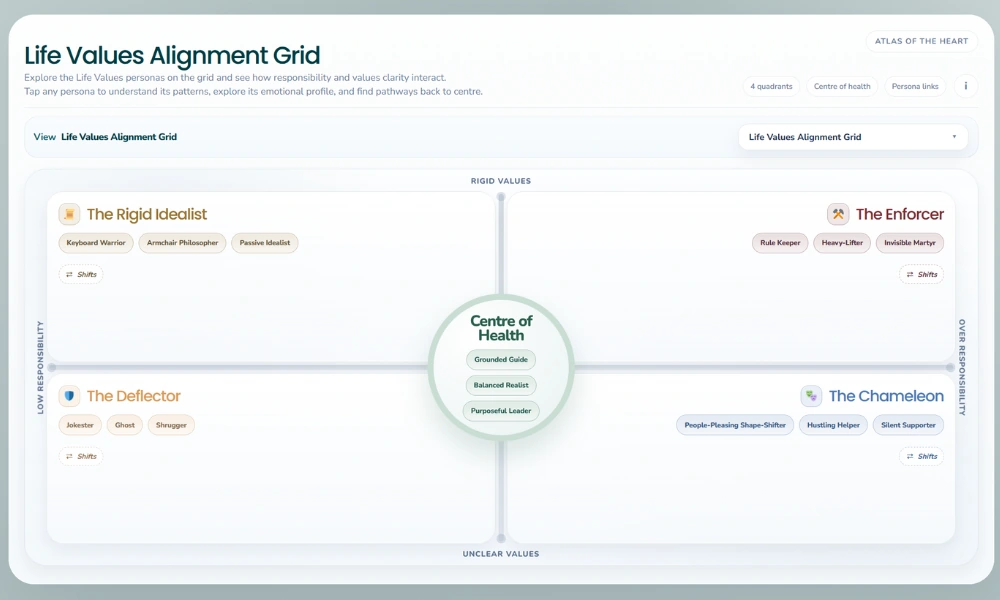
Where the tool becomes even more powerful is in how it links emotions to the Life Values Alignment Grid.
The Grid maps common patterns using values clarity and responsibility, helping people understand how they drift under stress into states like avoidance, people-pleasing, rigidity, or over-control, and even includes what returning to centre can look like.
Emotions & Values for Lasting Change
The grid is not here to label people, but to make patterns visible, immediately identifiable, so we can talk about them in a non-shaming way and create a clear path forward, back to the centre of health.
And here’s the thing, lasting change needs more than emotional insight alone.
Starting with awareness is great, but continuing with the Life Values Method – values work helps people tap into what really matters, and why.
Values unlock the pathway to reduce inner conflict, strengthen identity, and take more meaningful action.
It’s all laid out in the Life Values Method Practitioner handbook, so if you’re a therapists or practitioner, I encourage you to click here to learn more.
For now, if you’re looking for something smarter and more powerful than an emotions list or an emotion thesaurus, then check out the Emotion Explorer now.
It’s free to use, and here’s just a few ideas on how you can use it.
Use it to:
- Find more accurate words for what you / you’re clients are feeling
- Explore emotions more easily by category instead of scanning one giant list
- Understand patterns, groupings, differences and related emotions more easily
- See emotions with common persona’s on the Life Values Alignment Grid (preview only)
- Reflect on what your emotional state may be pointing to
- Connect emotional insight deeper layers, like values, life direction, relationships, meaning, and goals.
And for therapists and helping professionals in particular, another main benefit is having a rich, shared language to use with your clients. Don’t get lost is misinterpretation; instead have one clear tool for emotional literacy, and use it for deeper discussion and staying on the same page.
Try the Emotions Explorer
For Therapists & Practitioners
Become a Life Values Method Practitioner