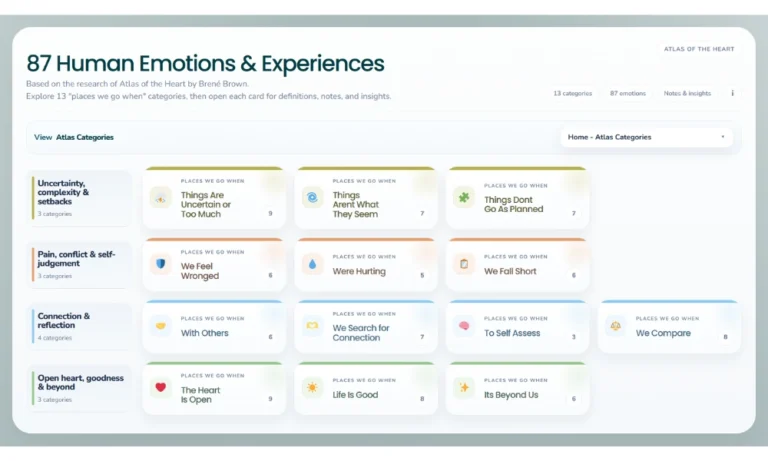
Explore all 87 Emotions and Experiences
The Emotions Explorer is an interactive tool designed to help people identify emotions more clearly, understand patterns more deeply, and make better sense of what is going on beneath the surface.
Based on Atlas of the heart by Brené Brown, It brings together emotional categories, values-based personas, relational patterns, and emotion mapping, all in the one place.
While the core draws heavily on the emotional language and research by Brené Brown’s Atlas of the Heart, it goes further by linking emotions to the core concepts I’ve developed inside the Life Values Method. Central – is the Life Values Alignment Grid. Here we map emotions with personal patterns created by values clarity, and responsibility level.
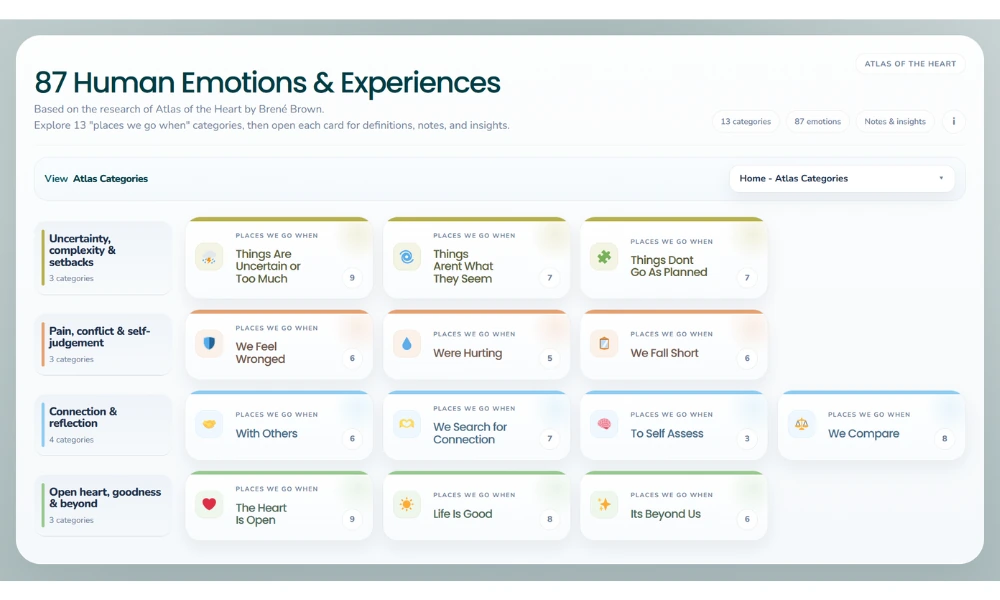
What it helps you do
More than just naming emotions, this app helps you:
- identify emotions with more precision
- understand the wider pattern around those emotions
- explore the pressures that shape and distort values and responsibility
- recognise common personas or protective styles
- reflect on relational positions and coping habits
- find language for healthier movement back toward centre
Why this matters
A lot of people know they are struggling, but they can’t easily explain what they’re feeling.
They might say:
“I’m angry”
“I’m stressed”
“I don’t know what’s wrong”
“I’m sad, or frustrated”
“I feel stuck, and I cant’ explain it.”
We need emotional awareness, and the right language, to create deeper meaningful and accurate insight.
Then we can name our emotions, and begin using these tools like a compass and a map to make better moves.
This app helps do all that. It bridges that gap by turning an emotional experience into something visual, click-able, and easier to explore.
As you explore, discover the emotional nuance, so you can get clear on what you or your clients are feeling. Then find the patterns, and use the special panels for guided reflection, and starting conversations – without shame or guilt.
How Emotions Pair with Values Work
One of the strongest parts of the Emotions Explorer is the Life Values Alignment Grid screen (pro only – see preview pictures below)
This screen helps people move beyond the question:
“What am I feeling?”
and into deeper questions such as:
- What pattern do I fall into under stress?
- Am I becoming rigid, unclear, avoidant, or over-responsible?
- How are my values showing up right now?
- Am I living from clarity, or reacting from pressure?
- What does returning to centre actually look like?
The grid maps emotional and ‘persona-style’ patterns into our four-quadrant framework based on values and responsibility.
For those unfamiliar with the Life Values Alignment Grid, it includes 4 quadrants, that are:
- The Rigid Idealist
- The Enforcer
- The Deflector
- The Chameleon
plus a Centre of Health position in the middle
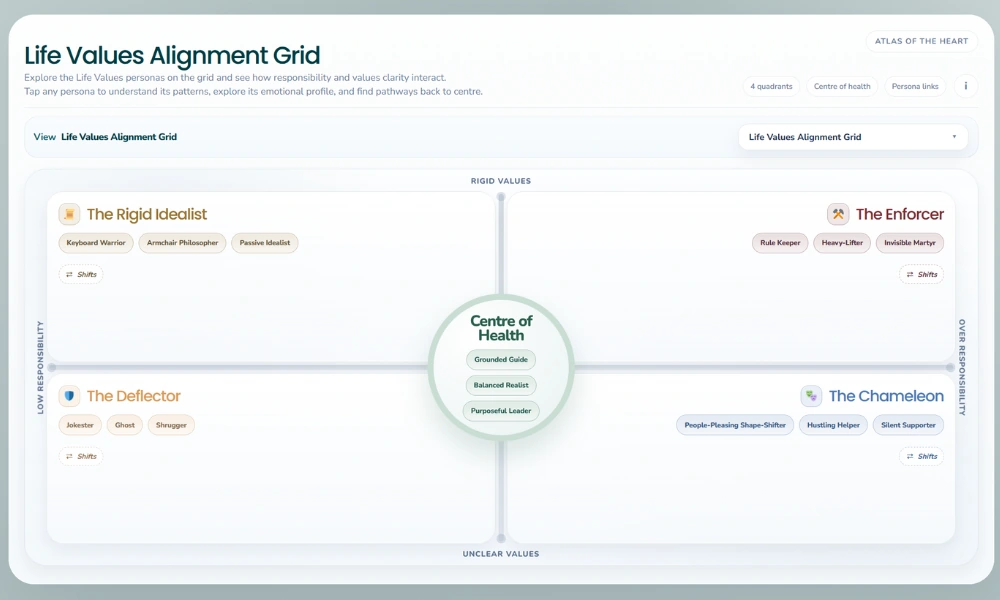
The Grid with persona + emotional mapping, makes it especially useful for people doing:
- personal development
- coaching
- counselling
- burnout recovery
- identity work
- self-awareness work
- behaviour change grounded in values
What Therapists Might Find Helpful
For practitioners, the interactive nature of the app gives you structure with flexibility, so you can have more meaningful conversations that stay grounded. (Avoid getting off-track, lost, repetitive, or ‘academic and abstract’.)
It can help clients:
- tune in, and find more accurate words for what they feel
- distinguish emotions from thoughts or behaviours
- see how emotional states connect to broader patterns
- explore protective personas without shame
- recognise movement between stuck positions
- discuss healthier realignment in concrete terms
In practice, that means the emotions explorer can be used as:
- a helpful tool to lead conversations
- a shared-screen for staying on track
- a coaching tool for building confidence, direction and momentum
- a workshop or teaching resource, to point to, and get on the same page
- a helpful tool for client ‘homework’ and personal reflection
- a conversation starter for values and behaviour work
- and so much more!
Put simply, it helps connect:
Emotions to patterns, to values, to responsibility levels, to relational dynamics, to healthier moves and decisions.
That makes it practical, not just informative.
How to Get Started
Simple – start exploring!
Just click through the emotion categories, or ‘places we go’ to get started. From there you can browse the common emotions to that ‘broad feeling’.
You can also browse all the emotions at once, and see what stands out for you or your clients. You do this by selecting a ‘screen mode’ from the main toolbar.
Here you will find:
- Home – Atlas categories this is ‘the places we go’ screen – default view
- All emotions by category – to view all emotions at once.
- Life Values Alignment Grid – to view personas on the grid (preview only)
- Emotion Dimensions Grid to view emotions by energy level, pleasantness, and more.
for therapists who have access to the pro version, (available inside the practitioners kit) you get access to two more screens.
1. The Life Values Alignment Grid screen allows you to view:
- all the persona’s on the grid.
- persona profiles with details, including:
- common emotions
- common patterns
- strategies to return to health
2. Terry’s relational grid – for couples counselling and relationship dynamics.

A Simple In-Session Example
Say a client comes in upset.
They are frustrated, angry, reactive, and maybe a bit flooded, but that is about all they can name at first.
They might be angry at their spouse, hurt by something that happened at work, or carrying a mix of resentment, pain, and confusion without having clear language for it.
As the therapist, you pull up the Emotions Explorer and start with the 13 Atlas-style categories.
You scan them together and your client quickly says,
“We feel wronged… that’s definitely me.”
Then they notice “We’re hurting” as well and realise that both categories feel relevant.
So you open them.
Inside We Feel Wronged, you might explore emotions like anger, resentment, contempt, or disgust. That alone can help the client slow down and get more precise.
Then you open We’re Hurting, and suddenly the conversation deepens. Under the anger, there may also be hurt, sadness, grief, despair, or anguish.
This clarity matters.
Instead of staying at the level of “I’m just angry”, the client starts to recognise that the anger may be carrying pain, disconnection, disappointment, or a sense of being unseen or wronged. The conversation becomes more honest, more specific, and more useful.
The quotes and insights panel can help here too. Sometimes a client reads a line and says, “Yes, that’s exactly it.” That can help them feel understood, reduce pressure, and create a shared language between you and the client.
From there, as the therapist, you can follow the work in a way that fits your approach.
This might include:
- staying with the feeling and helping the client feel heard
- exploring what happened and what the emotion is pointing to
- distinguishing anger from hurt, shame, grief, or fear
- linking the emotional reaction to a wider pattern (and their values)
- later, when the client is ready, exploring what a return to health or centre may look like
The app supports your process as a therapist, or professional, by making emotional experience easier to name, explore, and work with.
Try it Today
If you want a more visual and practical way to explore emotions, patterns, values, and all the wild and wonderful things that make us human, go ahead and try the Emotions Explorer today.
Click around. Explore the categories. Open the Alignment Grid. See what stands out.